Local SEO in 2026: We Analysed the Data Here's What Works
Seriously. If your local SEO is already working leads coming in, phone ringing, page one rankings locked you don't need this.
This is for the business owner who's been told their site is "fully optimized" but still can't figure out why the competitor down the street is ranking above them.
Still here?
Alright. Let's talk about what's actually going on.
Most SEO advice about local rankings is outdated. You still see the same tired guidance everywhere:
- Use exact match keywords everywhere
- Stuff the city name in every heading
- Buy an exact match domain
- Repeat the keyword in every section
But when you look at what's actually ranking at the top of local SERPs the data tells a completely different story.
And honestly? Some of it is going to upset old-school SEOs.
Because the pages ranking at the top are often the opposite of what you'd expect:
Losing Pages
- MORE keyword stuffed
- MORE exact-match focused
- Over-optimized headings
- Spammy title tags
- Keyword-crammed URLs
Winning Pages
- LESS keyword stuffed
- MORE branded
- MORE readable
- Semantically structured
- Entity-driven
Key Takeaway
Modern Google is far more focused on entities, trust, semantic relevance, and topical clarity than raw keyword repetition. Let's break down everything.
Title Tags: Google Clearly Hates Keyword Stuffing Now
This is one of the clearest patterns you'll find when studying local SERPs. Lower-ranking pages constantly look like this:
Simple. Branded. Natural. And it performs better consistently.
Shorter Titles Rank Better
That's surprisingly short. Concise titles improve CTR, readability, and trust and avoid the spam signals that come from piling on modifiers.
Did You Know
Google increasingly prefers titles that look like real businesses, not SEO experiments.
Exact Match Keywords Are Surprisingly Weak
Pages ranking #1-3 often use the exact search query less than lower-ranking pages. Google already understands service intent, location relevance, and semantic relationships. Modern Google doesn't need exact-match repetition anymore.
Brand-First SEO Is Winning
Branded pages consistently outperform keyword-stuffed ones. Winning title structures look like real businesses. Losing ones look like lead-gen spam. The gap is becoming increasingly wide.
Exact Match Domains Are Losing Power Fast
Years ago, exact match domains (EMDs) could rank almost automatically. That era is fading fast. Top-ranking pages increasingly have less keyword-matching in their domains than weaker pages.
Brand Domains Are Dominating
The strongest sites are usually recognizable businesses, established brands, and entity-driven websites. Google increasingly rewards entity authority, real-world branding, and user trust instead of raw keyword match.
Partial Match Domains Still Work Better Than Pure EMDs
best-[service]-in-[city]-cheap.com
[city][service]experts.com
Pro Tip
Partial match domains keep semantic relevance, feel brandable, and don't scream spam. That balance still matters. But a fully branded domain beats both, every time.
URL Structure: One of the Strongest Signals
Old SEO advice says "keep URLs short." But descriptive, hierarchical URLs consistently outperform flat or minimal ones for local service pages.
| Element | What Ranks | What Doesn't |
|---|---|---|
| Structure | /[service]/[city]/ | /services/ |
| Depth | Hierarchical & descriptive | Flat & minimal |
| Example | example.com/plumbing/austin/ | example.com/services/ |
Descriptive URLs improve topical relevance, crawl understanding, and semantic clarity. Google instantly understands what the page is about.
Dedicated Landing Pages Beat Homepage Targeting
One of the strongest findings: dedicated service + location landing pages consistently outrank homepage targeting. Google strongly prefers topical silos, location/service segmentation, and focused landing pages over trying to rank one homepage for everything.
Key Takeaway
Stop targeting local service keywords from your homepage. Build dedicated, nested landing pages at /[service]/[location]/ and watch the difference.
H1 Optimization: Cleaner Beats "SEO'd"
Top-ranking H1s are dramatically cleaner than what most SEO guides recommend. Lower-ranking pages commonly use headings like:
The keyword-stuffed version looks like pure SEO bait. The clean version looks like a real business. Google is getting very good at telling the difference.
Partial Match in H1: A Major Negative Signal
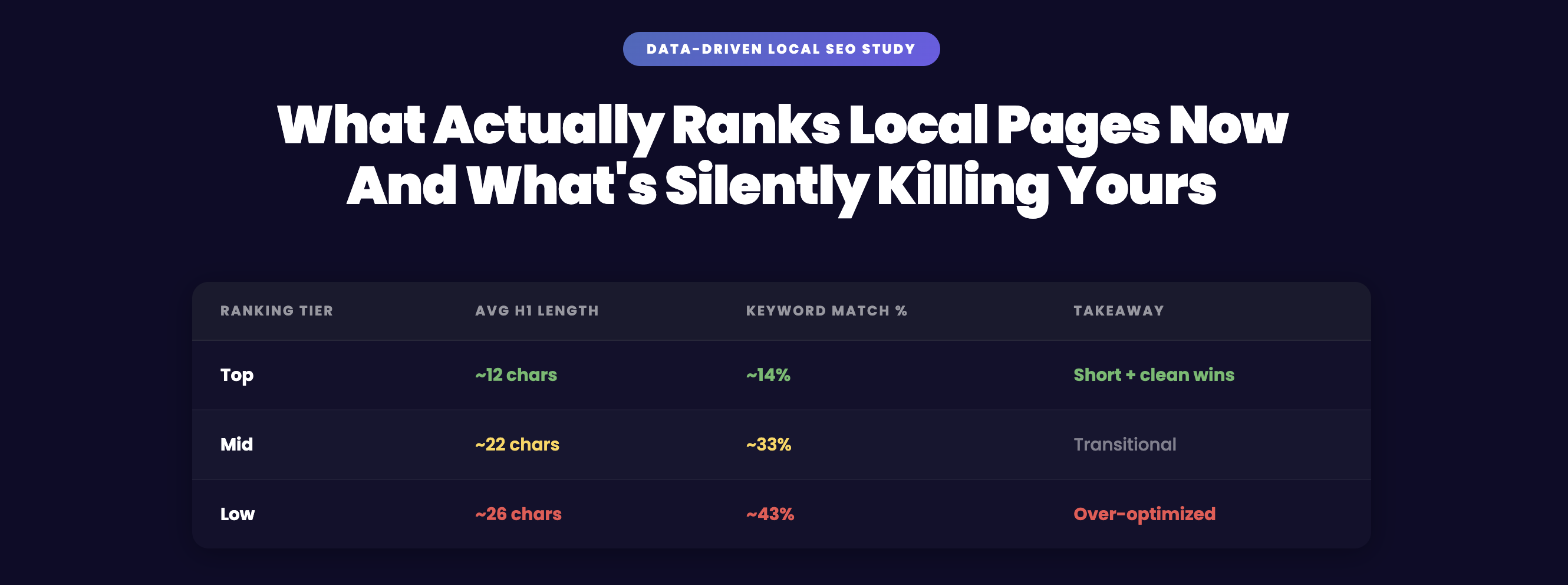
One of the clearest patterns across all local SERPs studied: top-ranking pages used significantly lower partial keyword match percentages in their H1 tags compared to lower-ranking pages. Pages overloading their H1 with keyword variations averaged far lower rankings.
H1 Character Length: Shorter Wins
The top-ranking pages had dramatically shorter H1 tags than low-ranking pages. Think headline, not keyword list. An H1 that reads like a newspaper headline outperforms one that reads like an SEO tag every time.
H2 & H3 Structure: Less Is More (With One Twist)
Winning pages use semantic headings, service-based sections, and user-focused organization instead of repeating location + keyword combinations across every heading.
Keyword-Stuffed H2s
- "[City] [Service] Services"
- "Best [City] [Service Provider]"
- "Affordable [City] [Service]"
- "Emergency [Service] [City] TX"
- "Cheap [Service] [City]"
Semantic H2s Ranked Better
- "Emergency Leak Repair"
- "Signs Your System Is Failing"
- "24/7 [Specific Service]"
- "Why Homeowners Trust Our Team"
Warning
Fewer, more meaningful headings consistently outperformed heading-heavy pages across every market. More headings does not equal better rankings.
The H3 Nuance Almost Everyone Misses
Here's where it gets interesting and where this contradicts what most SEOs assume:
While lower keyword match in H1 hurts rankings, the opposite is slightly true for H3 tags. Top pages actually had higher partial keyword relevance in their H3 sub-headings compared to lower-ranking pages.
The Distinction Matters
Keyword-stuffed H1s hurt you. Semantically relevant H3 sub-headings can help you. Keyword relevance can live deeper in the heading hierarchy just not at the top.
The right heading hierarchy looks like this:
Branded / Benefit-Led / Clean
Minimal keyword match. Reads like a real business headline.
Service Category Headings
User-focused, semantic. Organized by service type, not keyword variations.
Specific Sub-Topics
Where natural keyword relevance appears. Deeper detail, semantic depth.
This structure improves contextual relationships, topical mapping, and semantic understanding. Modern SEO is about topic coverage not keyword repetition.
Body Keyword Density: Near Zero Is the Target
This is a factor most modern SEO guides gloss over but the data is clear. Top-ranking pages maintain an extremely low exact-match keyword density in the body copy. Not just low. Near zero.
The second version uses zero exact-match repetition of the target phrase but it's the version that ranks. Why? Because Google understands service intent and location relevance from semantic signals, not from counting repetitions of the exact query string.
- Mention the exact query phrase once, naturally
- Confirm relevance through semantic, service-related language
- Don't repeat the phrase Google already understands it
Internal Linking: More Is Not Better
Another counterintuitive finding: lower-ranking pages often have far more internal links. Massive footers with hundreds of links, sidebar link farms, links in every section all of this dilutes topical authority rather than building it.
Strategic Internal Links Beat Volume
Top-ranking pages use a modest number of meaningful, contextual internal links not hundreds. Links that are service-relevant, naturally placed, and contextually appropriate. This strengthens topical authority in a way that link farms can't replicate.
Rule of Thumb
Every internal link should be there because a user would genuinely want to follow it not because you're trying to distribute link equity across every variation of your service pages.
External Links: Less Was More
Lower-ranking pages often link excessively to directories, partner sites, and random resources. Top pages are more selective they link externally only when it's useful, authoritative, and contextually relevant.
Modern Google appears to reward focused authority. Excessive outbound linking especially to low-quality or irrelevant destinations sends the wrong signals about your page's purpose and quality.
Schema Markup: Not a Magic Ranking Factor But Sub-Types Matter
This shocked many technical SEOs. Lower-ranking pages often use more schema markup than top-ranking ones. Schema alone doesn't improve rankings. It helps Google understand your page but it doesn't replace trust, authority, relevance, or UX quality.
Warning
Top-ranking pages consistently had less schema markup overall than lower-ranking pages. Schema is helpful but it's not a shortcut to better rankings. Adding more types of schema to compensate for weak content doesn't work.
Breadcrumb Schema: Don't Overthink It
Top pages use breadcrumb schema less than lower-ranking pages. If your site structure is shallow just a few pages deep breadcrumb schema is largely unnecessary overhead.
Overkill
- Adding BreadcrumbList schema to a flat 3-page local service site
- Stacking every schema type on every page
Better Approach
- Focus on content quality first
- Use schema only where it adds genuine value
FAQ Schema: The Exception Worth Adding
FAQ schema showed a slight positive signal. Top pages used it slightly more than mid and low pages. The reason isn't direct ranking uplift it's that FAQ schema can trigger rich snippet real estate in SERPs, expanding your result and improving CTR, which feeds back into rankings.
"Do you offer same-day service?"
"Are you licensed and insured?"
"What areas do you serve?"
3-5 genuine customer questions, not keyword-stuffed content
LocalBusiness Schema: The Only Non-Negotiable
For local service pages, LocalBusiness schema is the most consistently relevant schema type but only when implemented accurately with a single, clean instance.
Schema Overload
- LocalBusiness + FAQ + BreadcrumbList + Service + Review + HowTo stacked on every page
- Multiple conflicting schema blocks
- Schema data that doesn't match visible content
One Clean LocalBusiness Schema
- Accurate business name
- Real NAP (name, address, phone)
- Correct business hours
- Defined service area
Image SEO: Natural Optimization Won Again
The same anti-spam pattern that appears across headings and titles shows up with images. The report tracked three separate image attributes alt text, image src filenames, and image title attributes and found the same pattern in all three.
alt="best [service] [city] emergency [service] cheap [service] provider"
filename: [service]-[city]-emergency-[service]-cheap.jpg
alt="technician inspecting water heater"
filename: technician-water-heater-inspection.jpg
Pro Tip
Describe what's in the image for the user not for the crawler. Top pages had zero keyword stuffing across all three image attributes, consistently.
Text Formatting: Mostly Neutral Stop Obsessing
Many SEOs still bold keywords everywhere, highlight phrases repeatedly, and wrap target terms in formatting tags. The data shows almost no ranking advantage from any of this. Over-formatting often looks manipulative.
Keyword in span and li Tags: Zero Signal
Two specific formatting tactics many SEOs still obsess over wrapping keywords in span tags and bolding keywords inside li list items both showed identical results: zero ranking advantage across every market tested.
Formatting as SEO Tactic
- Wrapping keywords in tags
- Bolding the keyword 15+ times
- Keyword in every
- element
Format for Readers
- Bold for emphasis on real benefits
- Use formatting for readability, not signals
- Top pages: 0 avg keyword stuffing in span/li
Google is smart enough that bolding a keyword repeatedly does almost nothing for rankings. Format for humans.
Conversion Elements: Focused CTAs Outperformed CTA Clutter
Top pages more frequently included contact forms, quote forms, and clear calls-to-action. But there's a catch: too many CTAs hurt quality signals.
Structured Tables Helped Slightly
Pages using service comparison tables, pricing layouts, and structured data presentations performed slightly better. Google prefers organized information architecture and users convert better when information is scannable.
Plain Paragraph Pricing
- We offer various services at different price points depending on your situation and needs...
Structured Table
- Basic Service $X-$Y
- Emergency $X-$Y
- Full Install $X-$Y
Stop Writing More. Start Writing Less.
This one is going to hurt if you've been following the "long-form content wins" crowd. Because the data shows the opposite at least for local service pages.
Warning
The pages ranking lowest were writing nearly 3x more content than the pages ranking at the top. More words does not equal better rankings for local service pages.
Google Maps Embeds: Not a Local Ranking Signal
The conventional wisdom: embedding Google Maps on your local page signals to Google that you're a genuine local business. The data shows this is a myth.
If anything, top pages avoided heavy map embeds because their above-the-fold space was focused on conversion not on trust signals that don't convert or rank.
Common Mistake
- Full-screen Google Maps embed above the fold
- Thinking it proves local relevance to Google
Better Approach
- If you use a map, keep it small and below the fold
- Use above-the-fold space for your CTA and trust signals
The Biggest Lesson
The Old Strategy
- "Use the keyword everywhere"
- Optimize every element for the crawler
- Stack schema, stuff headings, repeat phrases
The New Strategy
- "Build the most trustworthy page possible"
- Semantically relevant, topically complete
- Entity-driven, brand-first, user-focused
Final Takeaway
This is why many "perfectly optimized" pages still fail to rank today. They're optimized for the 2018 algorithm, not the 2026 one. The pages that win aren't doing more they're doing fewer things, but doing them correctly.
Comments (0)
No comments yet. Be the first to share your thoughts.
Leave a Comment
Your comment will appear after approval.